Store visitors rarely identify themselves and cookie retargeting is fading. Learn how first-party tracking and identity resolution recover anonymous traffic.
By admin··13 min read
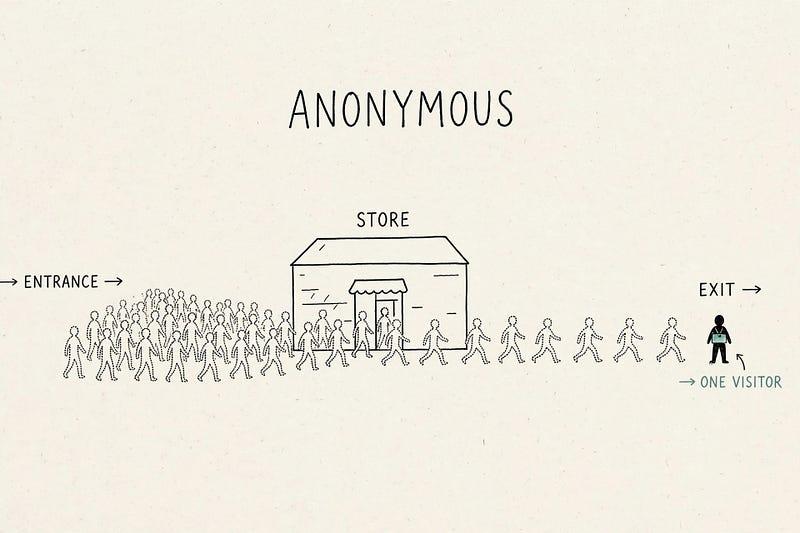
You check your analytics on a Monday morning. Ten thousand people visited your store last week. A few hundred bought something. A few hundred more left items in their carts. And the rest? They simply vanished—no name, no email address, no order, no way to reach them again.
This is the quiet leak at the heart of e-commerce. It is not the abandoned cart you can see in your dashboard. It is the much larger group you never get to see: the anonymous visitor. If you only market to people who identify themselves, you are building growth on a small minority of your traffic.
The visitors you never meet
Think about how you shop online yourself. You click a link, browse a category, open three or four product pages, compare prices, then a notification pulls you away or you simply close the tab. You did not create an account, sign up for a newsletter, or add anything to a cart. From the store’s point of view, you were a number in a traffic report, and nothing more.
Multiply that by thousands of visits a week. Most e-commerce traffic is anonymous by default: people browse before they commit, and commitment usually comes much later than the first visit, if it comes at all. Yet almost every recovery tactic assumes the opposite. Email flows assume you have an email address, SMS flows assume a phone number, and retargeting assumes you can recognise the same person elsewhere on the internet. For the anonymous majority, none of those assumptions hold.
The result is a strange asymmetry: stores invest heavily in getting traffic—search, social, influencers, paid ads—and then have no way to continue the conversation with most of the people that traffic brings in. Stores lose up to around 70% of potential sales to abandoned browse, cart, and checkout, according to nerja.ai’s own blog. But that figure only counts the losses you can measure. The anonymous browse that never became a cart is a loss on top of that—harder to count, and therefore easier to ignore.
Why “just retarget them” no longer works the way it used to
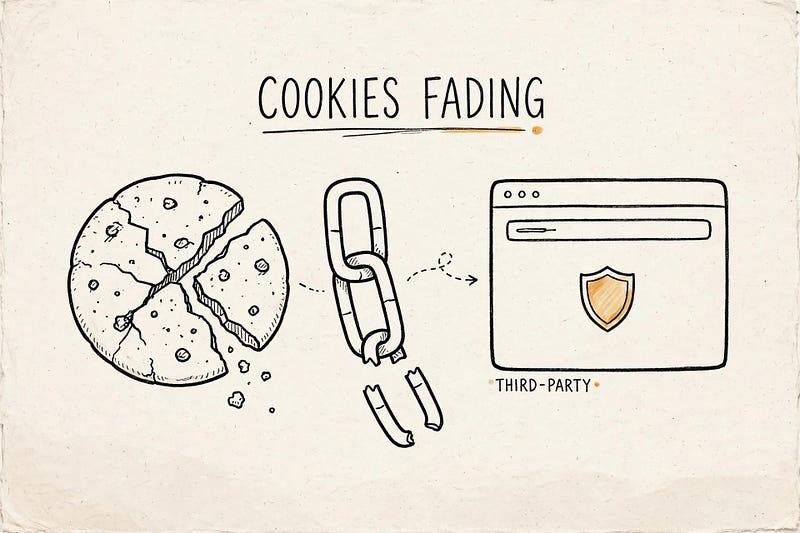
For years, the standard answer to anonymous traffic was third-party cookie retargeting: follow the visitor around the web with ads until they come back. That answer is breaking down, and store owners who still depend on it are feeling the effects even if they have not named the cause.
First, ad blockers are now mainstream. A meaningful share of your visitors never load a third-party tracker at all, so they never enter a retargeting audience in the first place.
The discount-dependency trap starts with one successful campaign and ends with shoppers waiting for price cuts. Here is how behavioral intelligence and intent scoring recover lost revenue while protecting your margins.
Learn how real-time intent scoring, first-party tracking, and autonomous AI campaigns turn abandoned browse, cart, and checkout sessions into recovered revenue across email, SMS, and WhatsApp.
Second, browsers have tightened the rules. Apple’s Intelligent Tracking Prevention (ITP) in Safari, along with similar restrictions elsewhere, shortens the life of third-party cookies and blocks many cross-site tracking techniques outright. A visitor you could once follow for weeks may now be unrecognisable within days.
Third, consent rules have changed what you are allowed to collect. Visitors in many regions must actively agree to tracking before it happens, and a large proportion decline or ignore the banner altogether. That is their right, and respecting it is good practice—but it means consent-based third-party tracking now covers a shrinking slice of your audience.
Put those three forces together and the old playbook looks fragile: you pay to bring people to your store, then rely on a mechanism many block, browsers degrade, and many never consent to. Retargeting built on borrowed identity—on someone else’s cookie, on someone else’s platform—is no longer a reliable foundation. The stores that recover anonymous traffic will be the ones that build their own, first-party understanding of who visits, what they do, and when they come back.
What identity resolution actually means
Identity resolution sounds like technical jargon. In plain terms, it is the work of answering a simple question: is this the same person I have seen before?
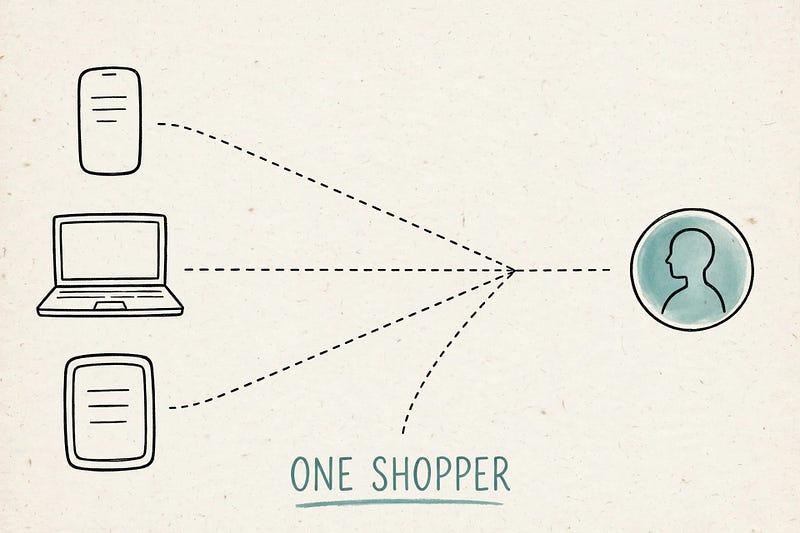
Without it, every visit looks like a new stranger. A shopper browses on a phone on Monday, returns on a laptop on Wednesday, and buys on a tablet on Friday: without resolution, that is three unrelated visitors and one lucky sale; with it, one person on a journey. Resolution connects small, legitimate signals left with consent into a single profile—an email at checkout, a login on a second device, a payment detail matching a previous order, a CRM record. Each signal alone is thin; stitched together, they show the categories a shopper returns to and the products they keep viewing without buying.
This is different from buying data or guessing who someone is. Good identity resolution does not invent an identity for a stranger. It connects the dots only where there is a genuine link—a shared login, a shared order, a shared device used with permission—and leaves the rest anonymous until the shopper chooses to identify themselves. A store that shortcuts this with fingerprinting tricks or purchased profiles risks trust and compliance problems that cost far more than the extra reach was ever worth.
Done properly, it changes three things. It stops you treating loyal browsers as strangers: you can recognise that a returning visitor looked at the same shoes three times this week, even without a cart. It connects behaviour across sessions and devices, so you see intent building up instead of judging each visit in isolation. And it makes recovery reach further without getting louder: a relevant, well-timed message to the person who actually showed interest, naming the exact product they viewed.
First-party tracking: owning the relationship instead of renting it
If identity resolution is the goal, first-party tracking is how you get there. The difference is who collects the data, and where it lives.
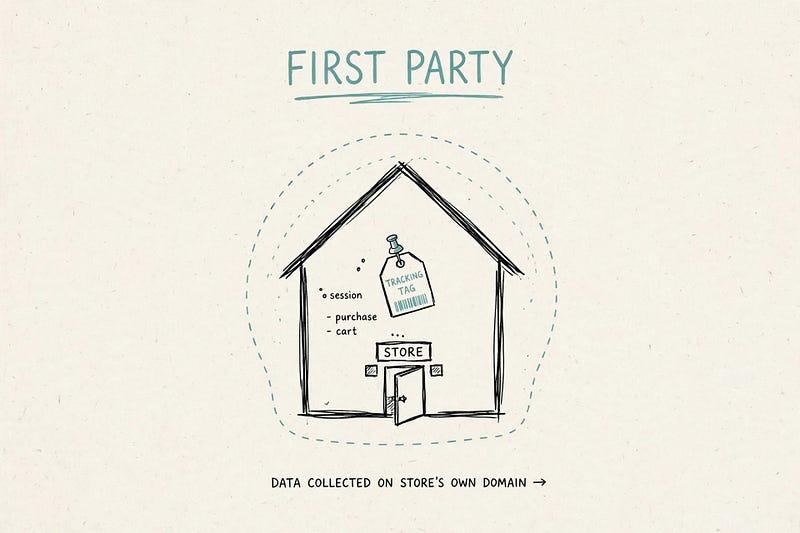
Third-party tracking puts a stranger’s script on your store and hopes that script survives ad-blockers, browser restrictions, and consent banners. First-party tracking uses your own domain—your own tracker, served as part of your own site—so the data is collected directly by you, under your own consent rules, and stored in your own system.
That shift has practical consequences. A first-party tracker is far more resilient to ad-blockers and to ITP-style restrictions, because it is not a cross-site tracker; it is part of the store itself. When implemented with a server-side CNAME setup, it becomes harder still for blockers to strip out, since the tracking traffic travels through your own domain rather than an obvious third-party endpoint.
But resilience alone is not the point. The point is control: you decide what is collected, how long it is kept, and who can access it. You are building an asset—an understanding of your own shoppers—that stays with your store, rather than renting an audience from an ad platform. That control carries responsibility: collect behaviour on your own store, with region-aware consent, clear data-subject rights, and safeguards like per-tenant salted hashing. If a tracking setup would embarrass you to explain to a customer in plain language, it is not worth keeping.
From anonymous to known: how the journey actually unfolds
It helps to walk through what this looks like for a real shopper.
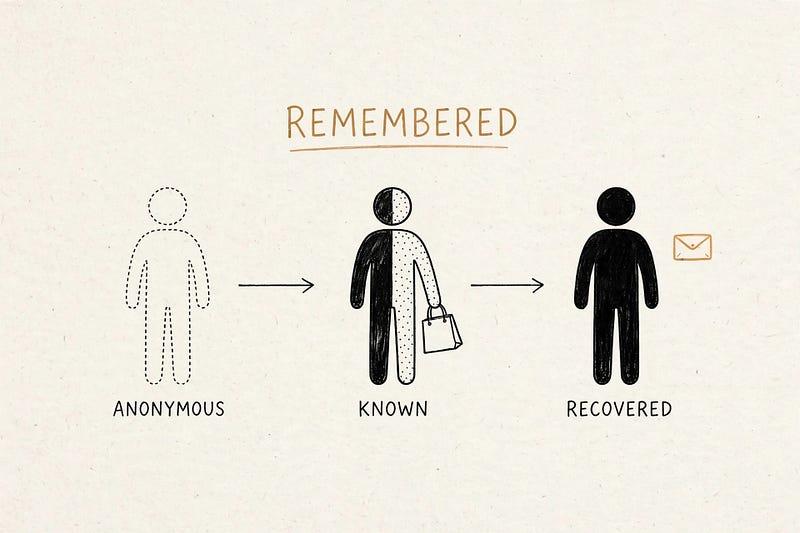
Day one: Sara finds your store through a search, browses winter jackets, opens two product pages, and leaves without adding anything to a cart. She stays anonymous, but her behaviour is recorded, first-party, with consent: which category, which products, how long she spent.
Day three: Sara returns on her phone, looks at the same jacket again, adds it to her cart, then gets distracted and abandons it. She still has not given you her email address—but because her sessions are connected, the store knows this is the same journey with rising intent, not a random new visit.
Day five: Sara comes back on her laptop and creates an account to check delivery options. At that moment, the anonymous journey and the known customer become one profile, and everything she did before is attached to a real person you can legitimately reach, through channels she has agreed to.
That is the moment recovery becomes possible—not because you chased her around the internet, but because you recognised her when she returned and waited for a genuine connection before reaching out. This is also why intent scoring matters alongside identity: a shopper who viewed a product once is not the same as one who returned to it four times and read the delivery policy. A heuristic scorer can separate those cases from day one, and a tenant-specific model, trained on a store’s own data after around 30 days, sharpens that judgement further. Intent plus identity turns a list of visitors into a list of priorities.
What changes when you can recognise returning visitors
Once anonymous journeys can be resolved into known profiles, the store’s marketing stops being generic in ways that are easy to feel as a shopper.
Browse recovery becomes possible for people who never reached a cart: a timely reminder naming the exact product, with its image and price and a link straight back to it, rather than a vague “we miss you” email. Cart recovery becomes smarter too—a smart delay, and follow-ups only if the shopper has not responded, so nobody gets a second “you forgot something” after buying. Checkout recovery becomes more human as well: someone who stopped at checkout was close, and something held them back, so a relevant message, with related product suggestions where appropriate, can address that moment directly.
Channels can also match the shopper: some respond to email, others to WhatsApp or SMS, some to push. Recovery across email, SMS, WhatsApp, push, and even AI voice calls means the message arrives where the shopper pays attention—provided they consented. And when journeys are stitched together, attribution stops being guesswork: with a clear rule, such as last-non-direct click within a seven-day window, the campaign view shows how much revenue recovery actually lifted.
The privacy question to ask before you buy any tool
Every vendor in this space will promise better recovery. Fewer will volunteer the details that determine whether that recovery is safe to build a business on. Before adopting any identity or tracking tool, ask these questions and be suspicious of vague answers:
Where does the data live, and who else can see it? Behaviour should be held per tenant, protected by salted hashing in a proper key-management system, not pooled into a shared dataset benefiting other stores.
What is sent to AI models? Contact details should never be sent to AI models; only aggregate audience summaries and product context should ground per-shopper copy. If a vendor cannot state that plainly, walk away.
How is consent handled across regions? Consent must be region-aware, not one banner copied everywhere, and shoppers must have real data-subject request endpoints.
Can you keep your data if you leave? Look for plans that let you keep your data even if you cancel, and free trials that do not demand a credit card upfront.
A practical starting point for this week
You do not need to rebuild your marketing stack to start fixing the anonymous-visitor problem:
Measure the gap. Compare total sessions with identified shoppers—accounts, checkouts started with an email, newsletter signups. The difference is your anonymous majority.
Move tracking first-party. Install a first-party tracker—a short snippet in your site’s head, backed by a server-side CNAME where possible so your behavioural data survives ad-blockers and browser restrictions.
Connect your existing systems. Link your store platform—Shopify, WooCommerce, Magento—with CRM and payment data into one identity view, sometimes called a data room. You likely already hold more identity signals than you use; they are just scattered across tools that do not talk to each other.
Set up the three recoveries that matter. Browse, cart, and checkout abandonment cover the full journey. Start with preset campaigns for each, then refine copy and timing from what you learn.
Let AI write the message, not decide the relationship. Use an AI agent to draft per-shopper copy grounded in your store’s knowledge base—the exact product, the real price—while keeping approval and consent rules firmly in place.
Review attribution weekly. Check the campaign view for revenue lift under a consistent window, and prune anything not earning its place.
The store that remembers wins
E-commerce has spent a decade optimising the last click: the checkout button, the discount code, the urgency banner. Those still matter, but they only serve shoppers who have already identified themselves and decided. The larger leak sits earlier, with visitors who leave without a trace—not lost causes, but browsers, comparers, and deliberators who buy from stores they trust once they are ready. The fix is not louder advertising or cleverer tracking tricks. It is a quieter shift: collect behaviour first-party, with consent; resolve identities across sessions and devices as genuine connections appear; and send fewer, more relevant messages at the right moment.
That is the approach nerja.ai is built around. Its tagline is “Recover Revenue with Behavioral Intelligence” and the anonymous visitor is where that intelligence starts. A short first-party tracker snippet in the site’s head, made resilient to ad-blockers and ITP through a server-side CNAME, captures behaviour on the store’s own domain. Its Data Room identity graph ties Shopify, WooCommerce, Magento, CRM, and payment records into one identity, so a shopper’s journey survives across sessions and devices. Its intent scoring heuristic from day one, tenant-specific models after 30 days of data prioritises who is actually close to buying. And its three preset recovery campaigns for browse, cart, and checkout abandonment, with AI-written per-shopper copy grounded in the store’s knowledge base, turn recognition into revenue: messages that name the exact product, show its image and price, link straight back to the cart, and only follow up if the shopper has not responded.
The Starter plan is free—1M events, 5,000 AI emails, and 50 AI SMS a month—and every paid plan, from Growth and Pro to Custom enterprise, is free for 15 days with no credit card required. Dashboards run in English, Bangla, and Arabic, and prices show in the store’s own currency, whether BDT, USD, or EUR. But whether you use nerja.ai or another tool, the principle stands on its own: stop building growth on the minority who identify themselves on day one, and start remembering the rest honestly, with consent, and across the whole journey.
Because the store that remembers its visitors is the store they come back to. And the store they come back to is the store they eventually buy from.