Every e-commerce owner knows the same frustration. Traffic comes in, products get viewed, carts get filled — and then, somehow, most of that interest never turns into revenue. The store is working, the ads are running, the products are good, yet money keeps leaking out through gaps that are hard to see and harder to fix one by one.
The leaks are rarely caused by a single mistake. They come from a set of connected problems: visitors who leave without buying, shoppers you cannot identify, discounts that train customers to wait, marketing reports that credit the wrong channel, follow-up messages that annoy more than they convert, and tracking that quietly breaks as browsers and ad blockers get stricter.
This post walks through six of those problems, one at a time, and explains how Nerja AI is built to address each of them. Nerja AI is an e-commerce revenue-recovery platform built around behavioral tracking, intent scoring, and automated recovery campaigns. Its tagline says it plainly: recover lost revenue, automatically. What follows is practical, not magical — what each problem looks like in a real store, and what a system designed for recovery actually does about it.
1. Abandoned Browse, Cart, and Checkout
The problem
Abandonment does not happen at one point. It happens at three.
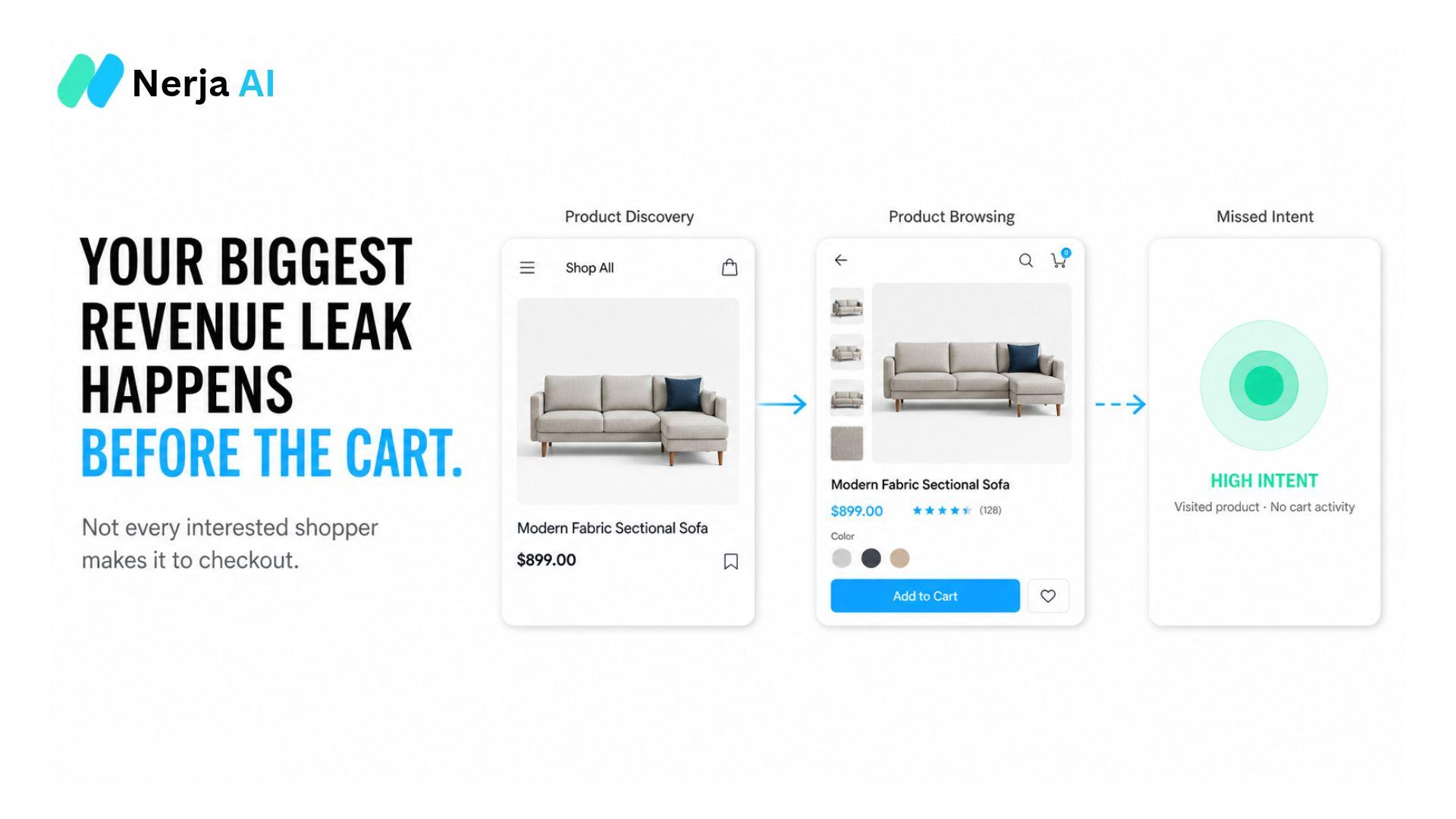
A shopper browses several products, compares options, and leaves without adding anything to the cart. That is browse abandonment, and it is the largest, quietest leak in most stores because nothing was ever “in the cart” to recover. Another shopper adds items, then gets distracted, hits an unexpected shipping cost, or decides to think about it. That is cart abandonment. A third shopper starts checkout, then stalls on payment, delivery options, or a forced account creation step. That is checkout abandonment — the most painful kind, because the intent was clearly there.
Most stores only chase the middle group, and only with a single generic reminder. The browser gets nothing. The checkout abandoner gets the same message as everyone else. Timing is guesswork, the message rarely mentions the exact product, and follow-ups either stop too early or keep arriving after the shopper has already bought.
How Nerja AI solves it
Nerja AI treats browse, cart, and checkout as three separate recovery campaigns, each with its own preset. That distinction matters, because a person who only looked at a product needs a different message from a person who was one click from paying.
Most stores focus all recovery efforts on cart abandoners, ignoring the far larger pool of high-intent browsers who leave without a trace. Learn how to spot and recover them.
Paid ads often claim sales that recovery emails and returning visitors actually drove. Learn how misattribution wastes spend — and what to check.
The cart recovery flow shows how the system works in practice. First, it identifies the shopper. Then it applies a smart delay, so the message does not arrive while the person is still deciding — or so late that they have already bought elsewhere. The message names the exact product, shows its image and price, suggests related products, and links straight back to the cart, removing as much friction as possible. Follow-ups only fire if the shopper has not responded, so a completed purchase does not trigger another nudge about the same cart.
The same thinking applies to browse and checkout recovery. Each campaign is built around the stage the shopper actually reached, rather than treating every lost visitor as the same case. Recovery becomes a sequence with a purpose, not a single blast sent to everyone who left.
2. Anonymous Visitors
The problem
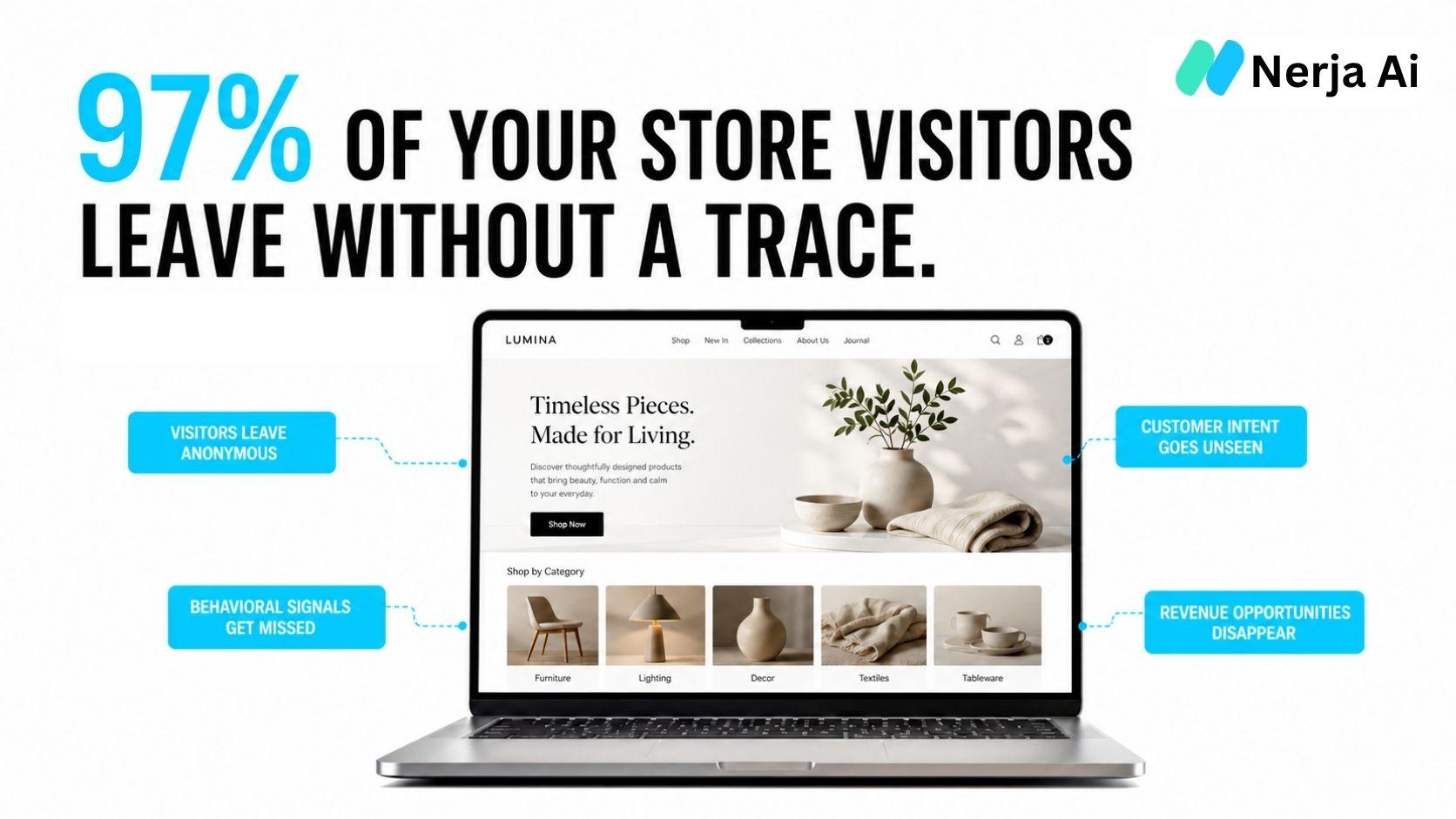
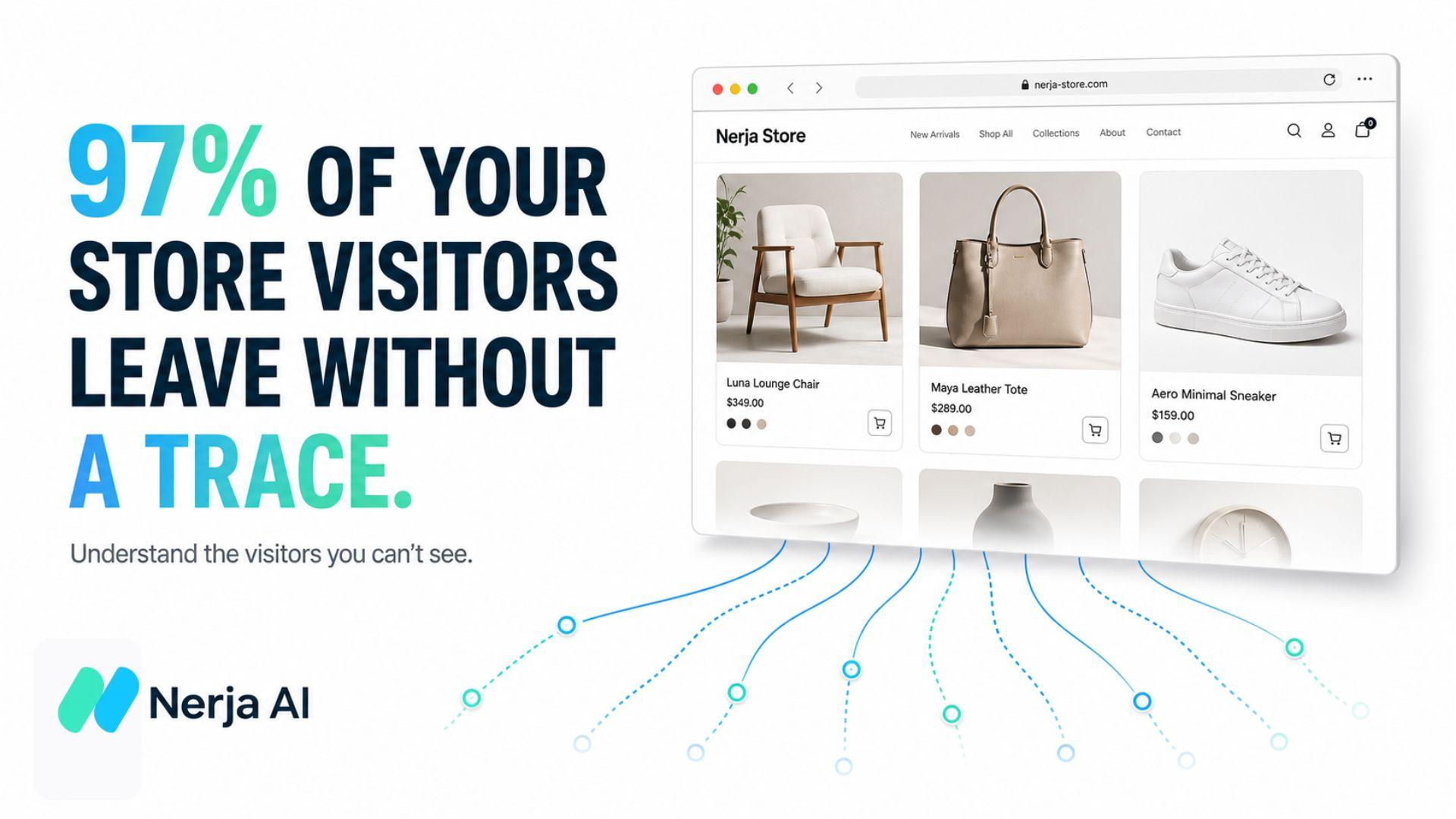
A large share of store traffic is anonymous. People browse without logging in, without subscribing, and without leaving an email address. Traditional email tools can only message people who are already on a list, so the store ends up spending money to attract visitors it cannot recognize when they return — or cannot reach at all once they leave.
Worse, the same person can look like three different people. They browse on a phone, come back on a laptop, and pay through a different channel. The store sees fragments: a Shopify order here, a WooCommerce session there, a payment record somewhere else. Without a way to connect those fragments, personalization stays shallow and recovery campaigns miss the very people they were meant to reach.
How Nerja AI solves it
Nerja AI builds an identity graph — called the Data Room — that ties Shopify, WooCommerce, Magento, CRM, and payment data into one identity. Instead of treating each session or channel as a separate stranger, the system connects the touchpoints that belong to the same shopper.
This is paired with a first-party tracker. A short, six-line snippet goes in the site’s head, and a server-side CNAME setup adds resilience against ad blockers and browser tracking restrictions. The point is straightforward: the store keeps its own view of its own visitors, rather than depending entirely on third-party cookies that browsers are steadily removing.
Identity is also what makes recovery possible for visitors who were previously unreachable. Once a shopper is identified — through a signup, a purchase, or another legitimate touchpoint — earlier browsing behavior can be connected to that identity, and the right recovery campaign can reach them on the channels where they can actually be contacted: email, SMS, WhatsApp, push, or AI voice calls.
3. Discount Dependency
The problem
Discounts work, until they become the strategy. A store offers a percentage off to win back an abandoned cart. It works once. Then shoppers learn the pattern: leave the cart, wait for the code. Margins shrink, full-price sales fall, and the store finds itself funding a habit it created. Every campaign becomes a race to offer more, and the customers who would have bought anyway get a discount they never needed.
The deeper issue is that a blanket discount treats every abandoner as price-sensitive. Some are. Many are not. Some left because they were distracted. Some wanted more information. Some were comparing delivery times. Sending all of them the same coupon wastes margin on people who only needed a reminder, and it teaches the rest to hold out for the next offer.
How Nerja AI solves it
Nerja AI approaches this with intent scoring rather than blanket discounting. Its heuristic scorer works from day one, and after 30 days of data, each tenant gets its own LightGBM model, alongside intent and churn models. In plain terms, the system learns which shoppers show strong buying signals and which are drifting away, so recovery effort can be matched to real intent instead of guessing.
That changes the message itself. Nerja AI’s AI agent writes per-shopper email, SMS, and WhatsApp copy grounded in the store’s own Knowledge Base — the actual products, policies, and details of that business — rather than a generic template with a coupon pasted on top. A shopper who needs a reminder gets a reminder that names the product they viewed. A shopper comparing options gets relevant related products. The conversation is about the product and the purchase, not only about the price cut.
The result is not “never discount.” It is “do not discount by default.” When a store can tell a high-intent shopper from a casual browser, it can reserve stronger offers for the cases that genuinely need them, and let relevance do the work everywhere else. That is how a store stops training customers to wait.
4. Misattribution: Not Knowing What Actually Worked
The problem
Ask a store owner which channel brought in a sale, and the honest answer is often “I am not sure.” An ad platform claims the sale. An email tool claims the same sale. A discount code gets the credit. A last-click report tells a different story from a first-click report, and none of them quite match the revenue in the bank.
Misattribution is expensive in a quiet way. It pushes budget toward channels that look effective because they claim conversions they did not create, and it starves the channels that genuinely introduced or recovered the customer. Recovery campaigns suffer most, because their value is easy to dismiss: if a shopper was “going to buy anyway,” the recovery email looks redundant — even when it was the nudge that actually closed the sale.
How Nerja AI solves it
Nerja AI keeps attribution deliberately simple and visible. It uses last-non-direct click attribution within a 7-day window, and revenue lift is shown directly in the campaign view. That means a store owner can open a campaign and see what it recovered, under a rule that is stated up front rather than buried in a reporting setting.
Simple does not mean simplistic. A stated window and a stated rule let a store compare campaigns fairly, spot which recovery sequence is earning its keep, and stop arguing with dashboards. When browse, cart, and checkout campaigns each show their own lift, the store can invest in the stage that leaks most, instead of spreading budget evenly across guesses.
For a small or mid-sized store, this clarity is the point. You do not need a more complicated model; you need one you can trust, applied consistently, where the people running the store can actually see it.
5. Over-Messaging: When Follow-Up Becomes Spam
The problem
Recovery campaigns fail in two opposite directions. Send too little, and the shopper forgets. Send too much, and the shopper unsubscribes, marks the message as spam, or decides the brand is desperate. The line between persistent and pushy is thin, and most automated sequences cross it because they are built around a fixed schedule, not around what the shopper has already done.
The classic mistake is the follow-up that ignores reality. The shopper already bought, but the “you left something behind” email arrives anyway. The shopper replied, but the sequence keeps going. The shopper browsed one product, and now receives a week of messages about products they never looked at. Each irrelevant message costs a little trust, and trust is what the next campaign runs on.
How Nerja AI solves it
Nerja AI builds restraint into the recovery flow. Follow-ups only fire if the shopper has not responded. That single rule removes the most common annoyance: being chased after you have already acted.
Relevance does the rest of the work. Because messages are written per shopper, grounded in the store’s Knowledge Base, and tied to the exact product browsed or left in the cart, the shopper receives fewer, more useful messages instead of a stream of generic ones. Related-product suggestions come from what the shopper actually looked at, not from a bestseller list blasted to everyone.
Channel choice matters here too. Nerja AI supports email, SMS, WhatsApp, push, and AI voice calls, but supporting a channel is not the same as using all of them at once on the same person. A store can reach shoppers where they are reachable, and let the recovery sequence stop the moment it has done its job.
6. Cookie and Tracking Loss
The problem
The tracking that e-commerce relied on for years is breaking. Browsers restrict third-party cookies, Intelligent Tracking Prevention shortens tracking windows, and ad blockers strip scripts before they run. A store can watch its analytics get thinner and its audiences shrink, without any single event to point to. Campaigns built on fragile tracking quietly lose their audience, and nobody notices until revenue dips.
This is not a problem a store can solve by adding more pixels. More third-party trackers just create more points of failure, more privacy risk, and more scripts slowing down the site. The stores that survive tracking loss are the ones that own their own first-party data and treat privacy as part of the system, not as a compliance afterthought.
How Nerja AI solves it
Nerja AI is built around first-party tracking from the start. The tracker is a six-line snippet in the site’s head — small, fast, and owned by the store’s own setup — with a server-side CNAME for resilience against ad blockers and browser restrictions. When the browser blocks a third-party script, the store’s own first-party view keeps working.
Privacy is handled with the same seriousness. Data is protected with per-tenant salted hashing in KMS, consent is region-aware, DSAR endpoints are provided, and the platform is EU-ready. Contact details are never sent to AI models; the AI agent works only from aggregate audience summaries and product context. That boundary matters: personalization does not require handing shopper contact details to a model, and a recovery platform should be able to say so clearly.
The practical payoff is durability. A store that tracks its own visitors, with consent, through its own first-party setup, does not lose its audience every time a browser changes a rule. Its recovery campaigns keep working because the underlying data keeps flowing.
Putting It Together: Recovery as a System, Not a Tactic
Looked at together, these six problems are really one problem: the store does not know its shoppers well enough, cannot reach them precisely enough, and cannot prove what worked. Fixing one piece in isolation — a better abandoned-cart email, a new discount, a different analytics tool — leaves the other leaks open.
Nerja AI is designed as a system for that whole loop. First-party tracking and the identity graph tell the store who its shoppers are. Intent scoring tells it who is ready, who is hesitating, and who is drifting. Three preset recovery campaigns — browse, cart, and checkout — turn that understanding into action, with per-shopper copy written by an AI agent grounded in the store’s own Knowledge Base. Attribution in the campaign view shows the revenue lift, so the store can see what the system actually recovered.
Getting started is deliberately low-risk. The Starter plan is free, with 1M events, 5,000 AI emails, and 50 AI SMS per month, and every paid plan — Growth, Pro, and Custom enterprise — is free for 15 days with no credit card required, with the option to cancel anytime and keep your data. Sending runs through established providers — Resend, Amazon SES, and AutoSend for email, with SMS and WhatsApp providers connectable — and the dashboard works in English, Bangla, and Arabic, with campaign copy in many languages and prices shown in the store’s own currency, including BDT, USD, and EUR.
No platform can promise to recover every lost sale, and this post does not claim that Nerja AI does. Shoppers will still change their minds, buy elsewhere, or simply browse for fun. What a recovery system can do is close the gaps that are actually fixable: the forgotten cart, the unrecognized visitor, the wasted discount, the misattributed sale, the message that arrived one time too many, and the tracking that stopped working. Fix those, and a meaningful share of revenue that was already visiting the store starts staying there.
If those six problems sound familiar, the next step is simple: put the tracker on your store, let the identity graph and intent scoring build their picture of your shoppers, and turn on the three recovery campaigns. The leaks you can see are the ones you can start recovering — automatically.
Store visitors rarely identify themselves and cookie retargeting is fading. Learn how first-party tracking and identity resolution recover anonymous traffic.